Downspout Drainage Repair NJ Stops Water Damage
A downspout that releases water next to your foundation can turn a routine rainstorm into an expensive property problem. Professional downspout drainage repair NJ homeowners can rely on addresses more than a loose elbow or clogged pipe. It corrects where roof runoff goes, how it moves through the property, and whether it is threatening the foundation, siding, basement, walkways, or landscaping.
New Jersey homes deal with heavy seasonal rain, snowmelt, freeze-thaw cycles, and leaf buildup that can push a drainage system past its limit. Water may look like it is draining properly during a light shower, then overflow, back up, or pool against the home during the next hard storm. The right repair starts with identifying the full path of the water, not simply replacing the visible damaged section.
Signs Your Downspout Drainage Needs Repair
Some drainage failures are obvious. A downspout may have detached from the gutter, cracked along a seam, or emptied directly into a mulch bed beside the house. Other problems develop quietly, with warning signs appearing around the exterior or inside the lower level of the home.
Watch for water pooling near the foundation after rain, soil erosion beneath downspouts, damp basement walls, musty odors, peeling exterior paint, or staining on siding and masonry. You may also notice that a downspout gurgles, overflows at the top, or stays full long after the rain has stopped. These issues can point to a clog, poor pitch, crushed underground pipe, or an outlet that cannot handle the volume of runoff.
Foundation concerns deserve prompt attention. Constant moisture can place pressure on below-grade walls, contribute to cracks, and allow water to find its way through small openings. Even when no water enters the basement, runoff that repeatedly saturates the soil near the home can create long-term risk.
What Causes Downspout Drainage Problems in NJ?
Downspouts are part of a connected water-management system. The roof collects rain, gutters carry it to the downspouts, and downspouts direct it safely away from the structure. A problem in any part of that chain can cause failure at the bottom.
Clogged gutters are a common starting point. Leaves, roof grit, twigs, and debris can prevent water from reaching the downspout opening. In winter, ice can worsen a blockage and force water over the gutter edge. If the gutter is loose, sagging, undersized, or pitched incorrectly, water may bypass the downspout even when the downspout itself is clear.
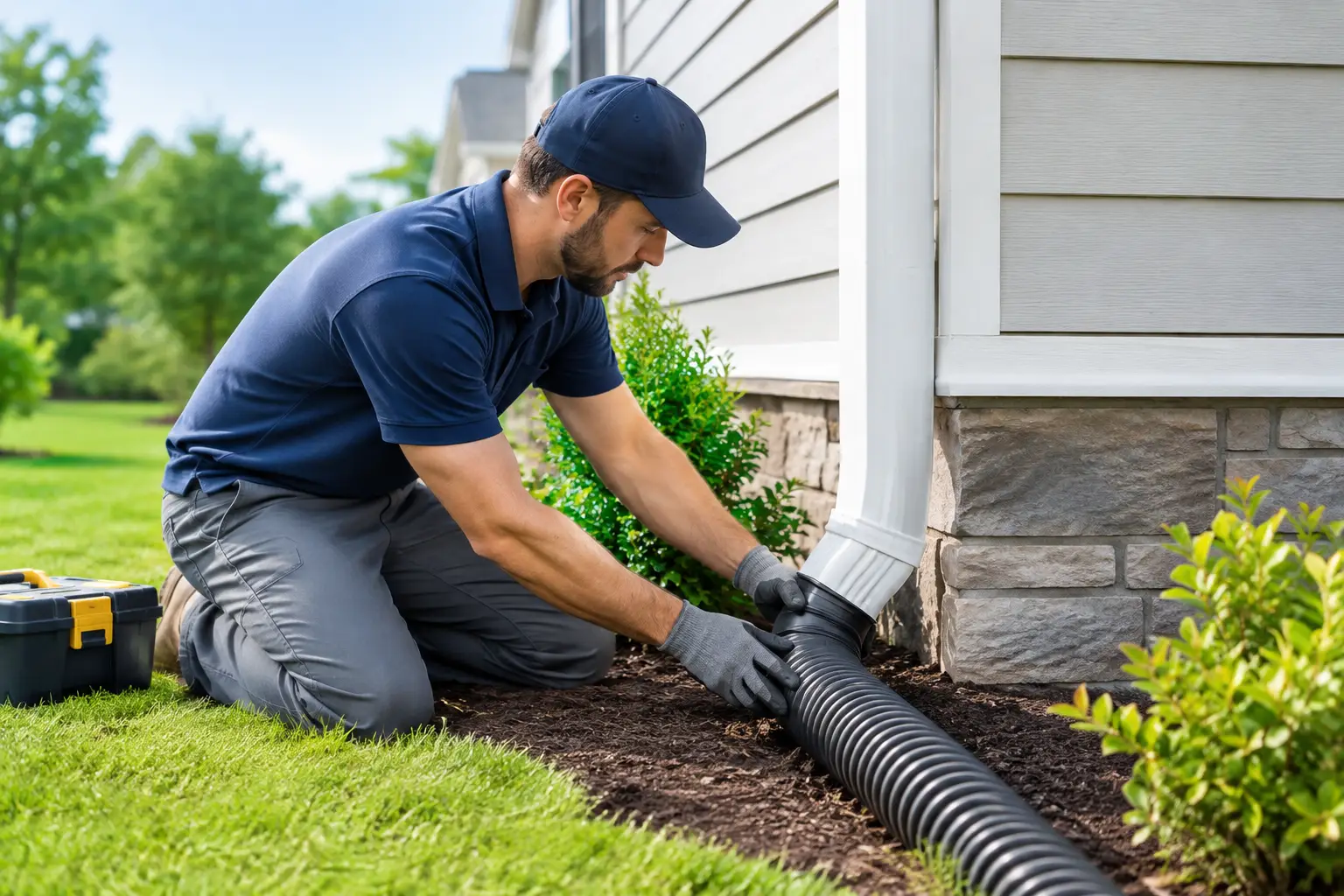
At ground level, short extensions and poorly placed splash blocks often leave water too close to the foundation. A downspout should carry water far enough away that it does not flow back toward the home. The required distance depends on the property grade, soil conditions, hardscaping, and drainage layout. A steeply sloped yard may need a different solution than a flat yard with dense clay soil.
Underground drain lines create another set of concerns. These pipes can clog with sediment, become disconnected, crack from age, or collapse under shifting soil. Tree roots may also enter joints and restrict flow. If water disappears into an underground line but resurfaces near the house or backs up during storms, the buried drainage system needs to be inspected rather than assumed to be working.
Downspout Drainage Repair NJ Property Owners May Need
The proper repair depends on what the inspection finds. A simple issue, such as a separated elbow or a missing extension, can often be corrected quickly. More extensive water problems may require coordinated work involving gutters, siding, grading, masonry, or underground drainage.
Downspout Reattachment and Replacement
Wind, ice, impact damage, and aging fasteners can pull a downspout away from the gutter or wall. Reattaching it correctly matters because a loose downspout can leak at the joint, damage siding, and direct water onto the foundation. If the metal is badly corroded, dented, or split, replacement is usually the more durable option.
A properly installed downspout should be securely fastened, aligned with the gutter outlet, and fitted with sealed connections that guide water downward without leaking. Color-matched components can also protect the look of the home while restoring performance.
Clog Removal and Drain Line Repair
A visible clog near the bottom of a downspout may be removable without major work. However, recurring backups should not be treated as a one-time cleanup issue. The system may have an obstruction farther down, an undersized outlet, or a buried line that is no longer draining correctly.
Drain line repair may involve clearing debris, replacing a damaged section, reconnecting separated pipe, or rerouting water to a more appropriate discharge point. The goal is not just to make water disappear temporarily. It is to create reliable drainage during the storms that place the greatest demand on the system.
Extensions, Splash Blocks, and Rerouting
For many homes, the repair is as practical as extending the discharge point away from the foundation. Above-ground extensions are often cost-effective and easy to maintain, particularly where the yard has enough open space and natural slope. Splash blocks can help spread water and limit soil erosion, but they are not always enough for flat properties or high-volume roof sections.
Rerouting may be the better answer when water is directed toward a driveway, walkway, neighboring property, or low spot in the yard. A repair plan should consider where runoff will travel after it leaves the downspout. Moving the problem from the foundation to a slippery walkway or flooded garden is not a complete solution.
Gutter and Exterior Repairs That Support Drainage
Downspout repairs can fail if the gutters feeding them are in poor condition. Sagging sections, leaking seams, loose hangers, and improper gutter pitch all interfere with water flow. Damaged siding, rotted fascia, and deteriorated masonry may also need attention if water has been escaping behind the drainage system.
This is where working with a contractor experienced in the full exterior envelope makes a difference. Top Pros Construction LLC can evaluate connected roof, gutter, siding, chimney, and masonry concerns so homeowners are not left coordinating separate trades when one water issue has affected multiple areas.
Why Quick Repairs Protect More Than the Foundation
Ignoring a drainage problem can create damage that spreads beyond the original downspout. Overflowing water can wash away landscaping, undermine pavers, stain brick, and splash dirt onto siding. It can also contribute to wood rot around fascia boards, soffits, trim, and window areas.
During colder weather, poor drainage can create hazardous ice near entrances and walkways. Water that repeatedly freezes inside seams, elbows, and drain connections can widen small defects until the system separates. New Jersey’s changing weather makes preventive repairs especially valuable because a small drainage weakness can be exposed by rain, snow, and freezing temperatures in the same season.
There is also a cost consideration. A targeted repair completed early is often less disruptive than waiting for basement water, damaged siding, or foundation-related concerns to appear. That does not mean every drainage issue requires a major replacement. A qualified inspection helps determine whether a straightforward correction will provide lasting protection or whether the property needs a larger drainage update.
What a Professional Drainage Inspection Should Include
A useful inspection looks beyond the section of downspout that is easiest to see. The contractor should check the roofline and gutters for overflow patterns, confirm that downspouts are securely connected, assess the condition of elbows and extensions, and follow the water route to its final discharge area.
For homes with underground drainage, the evaluation should account for signs of blockage, backup, settlement, or failed connections. The surrounding grade should also be considered. Even a properly functioning downspout cannot solve a yard that slopes toward the foundation.
Homeowners should expect clear recommendations and an up-front explanation of the work. In some cases, cleaning and a new extension are enough. In others, replacing damaged gutter sections, repairing an underground line, or adjusting the drainage route will offer better long-term results. The best approach is the one that fits the home’s condition, water volume, and property layout.
When to Call for Help
Call for an inspection if water is entering the basement, pooling against the foundation, overflowing from gutters, or creating erosion after storms. Prompt attention is also wise when a downspout has come loose, a drain line repeatedly backs up, or ice is forming where people walk.
If heavy rain is actively causing roof or exterior water intrusion, do not wait for the weather to create more damage. Document visible conditions when safe to do so, keep people away from slippery areas, and arrange for a professional assessment as soon as possible.
Your downspouts may be small compared with your roof, but they carry every gallon of water your roof collects. Keeping that water moving safely away from the home is one of the most practical ways to protect the exterior you have invested in.